Wagon Lit Uniform Button
The Wagon Lit Uniform Button is a small, seemingly insignificant object that plays a pivotal role in the investigation of Samuel Edward Ratchett's murder on the Orient Express. Found by Caroline Martha Hubbard in her compartment, the button initially appears to be a straightforward clue pointing to a mysterious intruder disguised as a train conductor. However, as Hercule Poirot's investigation deepens, the button's true significance emerges as part of an elaborate, carefully staged crime scene, ultimately contributing to the revelation that the murder was a collective act of vengeance carried out by twelve passengers connected to the Armstrong family tragedy.
Discovery and Initial Interpretation
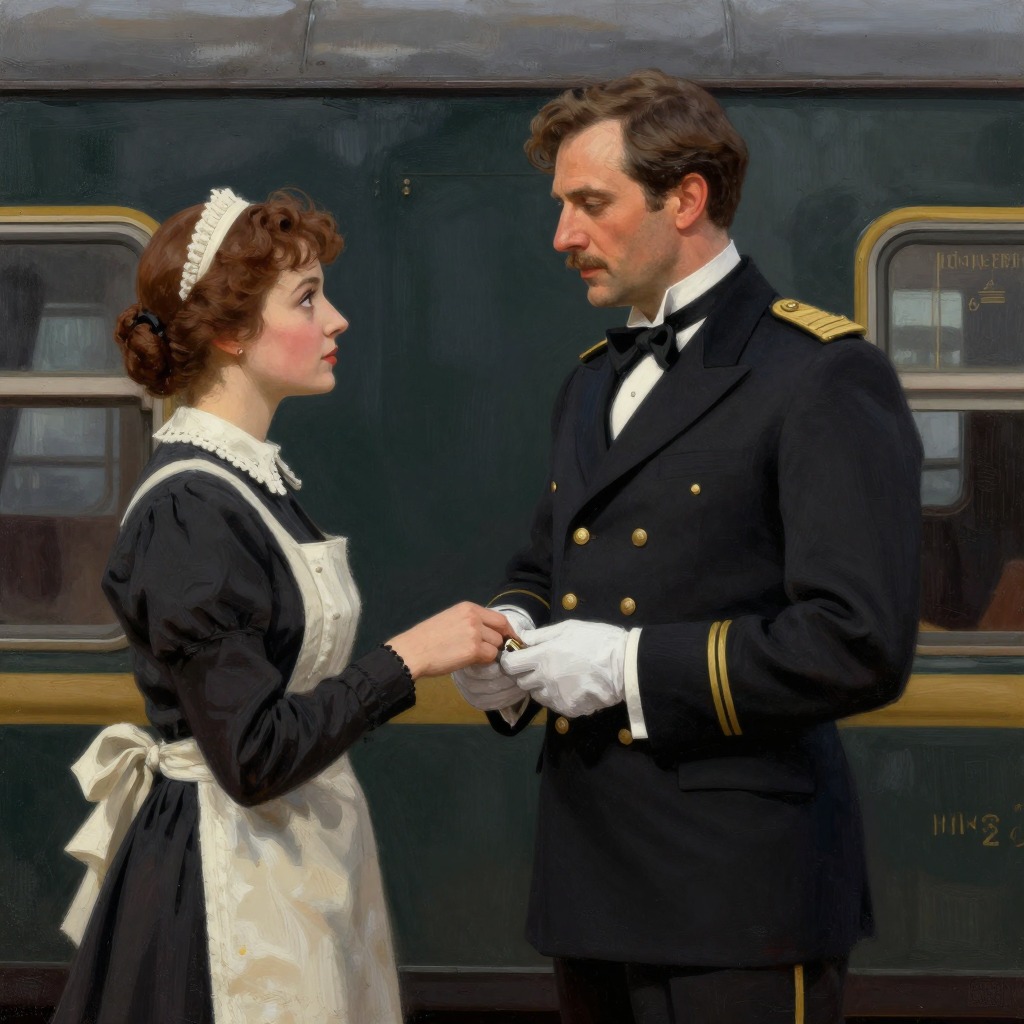
The button came to light when Mrs. Hubbard, the American lady occupying compartment No. 3, presented it to Poirot and his colleagues during her testimony. She had found it that morning lying on top of a magazine she had placed on a case near the window the night before. Mrs. Hubbard was adamant that the button was not hers and that it had not been there when she went to sleep. She insisted that it was proof that a man had been in her compartment during the night, a claim the conductor had dismissed as a dream. M. Bouc immediately identified the object: "But this is a button from the tunic of a Wagon Lit attendant!" This identification seemed to confirm Mrs. Hubbard's story and suggested that the intruder had been wearing a conductor's uniform, losing the button as he passed through her compartment after committing the murder.
The Button as a False Clue
Despite its apparent value, Poirot quickly became suspicious of the button's convenient placement. He noted that the crime scene was "full of clues," including a woman's handkerchief marked with an "H" and a pipe-cleaner, and he questioned whether these items were genuine oversights or deliberately planted misdirections. The button, like the other clues, seemed too perfect. Poirot reasoned that a real criminal would not make such an obvious mistake. The button's presence in Mrs. Hubbard's compartment, combined with the other clues, was part of an intricate plan to confuse the investigation and cast suspicion on an imaginary "small dark man with a womanish voice"—a description that conveniently matched no one on the train. The button was a red herring, designed to support the false narrative of an outside assassin who had disguised himself as a conductor and then vanished.
Connection to the Conspiracy
The button's true meaning was unlocked only when Poirot uncovered the full extent of the conspiracy. The twelve passengers in the Stamboul-Calais coach were not strangers but a self-appointed jury of executioners, each connected to the Armstrong family, whose child Ratchett (under his real name, Cassetti) had kidnapped and murdered. The button was a manufactured clue, part of the elaborate staging that included the threatening letters, the dented watch, and the pipe-cleaner. Its purpose was to support the alibi of the real conductor, Pierre Michel, who was himself a member of the conspiracy—the father of Susanne, the French nursemaid who had committed suicide after being wrongly suspected in the Armstrong case. By planting a button from a Wagon Lit uniform, the conspirators aimed to make it appear that an impostor had committed the crime, thereby protecting Michel and further obscuring the truth.
Significance in the Solution
In his final summation, Poirot presented two possible solutions to the crime. The first, a deliberately false solution, relied on the button as evidence of an outside intruder who had left the train before it was snowbound. The second, true solution, revealed that the button was a deliberate plant, one of many "clues" dropped to confuse the issue. The button, therefore, was not a piece of evidence that led to the murderer but a piece of the conspirators' own design, a testament to their meticulous planning. Its presence in Mrs. Hubbard's compartment was a calculated act, not a mistake. The button's journey from a uniform tunic to a crime scene prop encapsulates the novel's central theme: that in this case, the evidence itself was a fiction, and the truth could only be found by seeing through the carefully constructed facade.